The Hidden Costs of "Free" Software: Flexibility vs Commercial Polish
Open source is never free. Not in regulated environments. Not in DoD mission systems. Not in any place where uptime, security, traceability, or accreditation matter. You can get incredible capability from open ecosystems, but if you want something that actually holds up in production, you will pay for it one way or another.
Organizations love the idea of “just use open source.” On paper, it sounds clean. It’s flexible. It’s free. And if you squint hard enough, it looks like a shortcut to digital transformation.
But here’s the honest read: open source is never free. Not in regulated environments. Not in DoD mission systems. Not in any place where uptime, security, traceability, or accreditation matter. You can get incredible capability from open ecosystems, but if you want something that actually holds up in production, you will pay for it one way or another.
At BrainGu, we believe in open ecosystems. We contribute to them, and SmoothGlue builds on top of them—but we also operate in the real world. If you want commercial polish and mission-grade reliability, you need more than a GitHub folder. You need engineering discipline, lifecycle management, compliance automation, and a path to accreditation. That’s where the real cost lives.
This post walks through what “just use open source” actually means, why the operational burden is consistently underestimated, and how SmoothGlue strikes the balance between open flexibility and productized reliability.
“Free” open source gives you the parts, but it does not give you a working platform. And it definitely doesn’t give you a path to mission-ready accreditation.
If you attempt to recreate what SmoothGlue provides using only open-source components, here’s the starter list of what you’re signing up for.
Each one of those tools needs to talk to several others. You'll spend months reading documentation, resolving version mismatches, writing glue code, mapping identity flows, and trying to decipher mesh failures.
This is where most teams underestimate effort. Integration is not a one-time task. It is continuous. Every update, patch, or CVE nudges you off balance.
If you’re in a disconnected or classified environment, multiply the pain. Images must be mirrored. Charts must be patched for offline URLs. Binaries are staged, OS repos cloned, and documentation needs to be preserved because you can’t search the internet.
Tools like Zarf or Hauler help, but now you’ve added yet another layer to the stack.
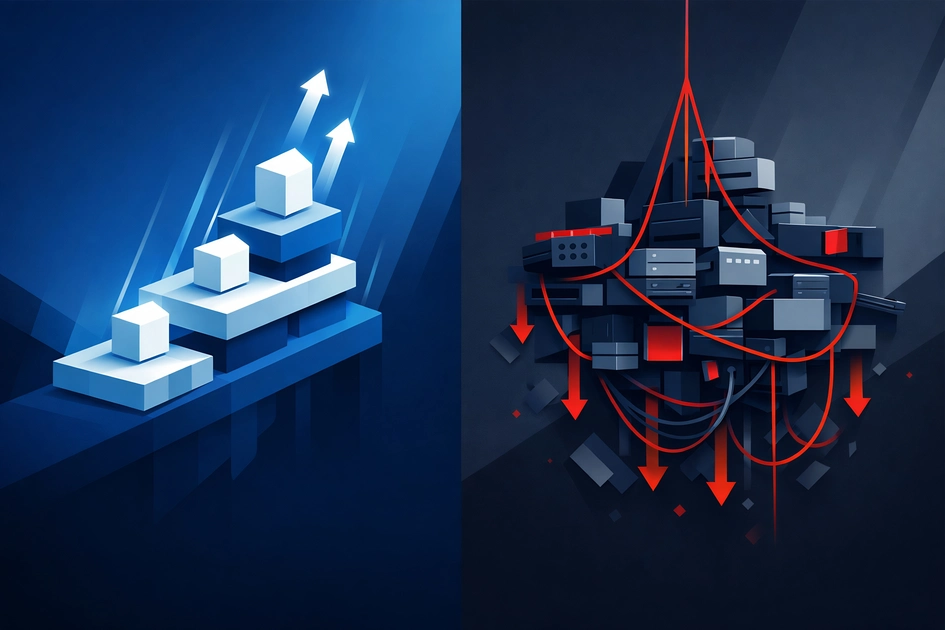
This is why so many teams get stuck on Kubernetes 1.24 three years later. Every update risks breaking the tower they built out of duct tape and optimism.
Tested combinations across 35+ tightly coupled tools.
One deployment artifact instead of dozens of Helm charts and interdependent configs.
Air-gap native packaging built for disconnected from day one.
Unified operations through a single CLI to install, configure, upgrade, or tear down.
A version matrix so upgrades are predictable, not roulette.
Full compliance automation that produces a ready-to-submit Body of Evidence.
Enterprise-ready security baked directly into the platform, not bolted on after the fact.
Deployment flexibility from cloud to edge to TS//SCI networks.
Open source remains open. You can customize anything. But SmoothGlue lets you start from a working, mission-ready baseline instead of a spreadsheet full of unresolved dependencies and contradictory documentation.
We don’t treat open source as a competitor. We treat it as the foundation.
SmoothGlue integrates cleanly into platforms like Platform One’s Big Bang, and we contribute upstream to make the ecosystem better for everybody. We sit on the Platform One Technical Oversight Committee, enhance Big Bang and Iron Bank, and build on open standards to support improvements.
This is the balance: open contribution, but with commercial-grade productization.
Proof Point: Mission-Ready, Not Just Market-Ready #
Our customers don’t buy SmoothGlue because it’s shiny. They buy it because it works in the hardest possible places.
Full ATOs at IL4, IL6, and TS//SCI, including a 5-year package at TS//SCI.
Running production workloads across USAF, ABMS CBC2, Kessel Run, Unified Platform, and multiple intelligence frameworks.
Deploys mission-ready in under two hours in cloud environments.
Installs and configures end-to-end at IL4+ in under two days.
Built-in guardrails for reliability and security at every layer.
Supports thousands of concurrent users across the continent.
Designed for cloud, on-prem, and edge deployments with the same operational model.
This is what commercial polish looks like when applied to open tools. Not pretty UI chrome. Predictability. Repeatability. Security. Outcomes.
Open source is a powerful starting point, but building a mission-grade platform from scratch is not free, fast, or simple. It’s an engineering marathon that quietly drains time, budget, and focus from the real goal: delivering capability.
SmoothGlue gives teams a way out of the operational slog. You get the flexibility of open ecosystems with the reliability of commercial productization. You get to innovate instead of spending your year wiring together YAML files.
That’s the tradeoff. Not open vs closed. Not free vs paid. It’s whether you want to spend your time integrating infrastructure or delivering impact.
At BrainGu, we built SmoothGlue so you don’t have to choose between flexibility and polish. You get both. And your mission gets what it actually needs: software that works.
Move fast without breaking things. Built-in guardrails keep your apps secure, compliant, and resilient—no matter where you deploy.
👉 Start building on the platform that scales with you.
SmoothGlue 7.0 introduces the revolutionary SmoothGlue Data Mesh, unifying data across distributed systems to empower organizations to build intelligent, connected, and AI-driven applications with unprecedented speed and security.
Product lift beats services drag. In defense, the teams that standardize on productized platforms compound speed, security, and learning. Services can be useful, but service-heavy delivery adds friction that kills timelines and blows budgets.

 SmoothGlue Unveils 7.0, Featuring an Integrated Data Mesh to Power Real-Time, Mission-Critical Enterprises